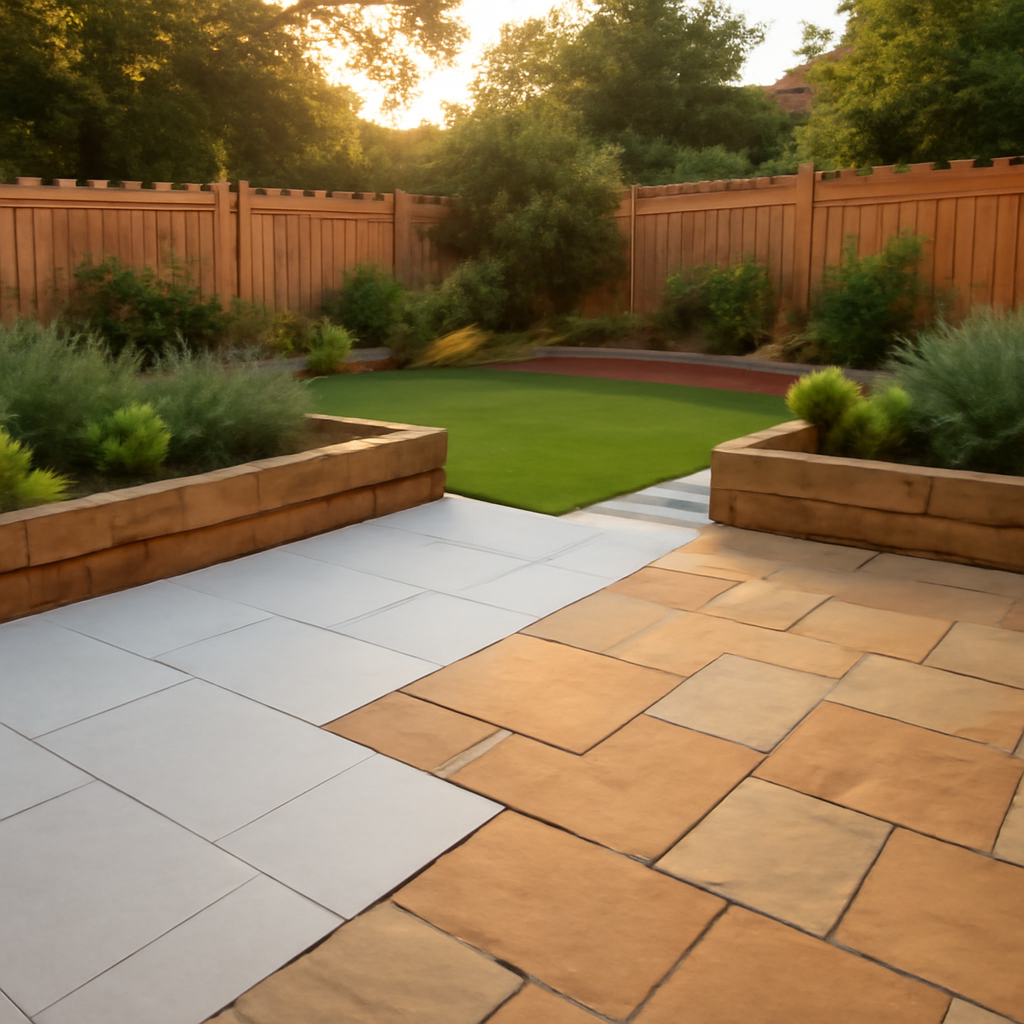
Choosing the right paving material for your garden in Loughborough or elsewhere in the East Midlands is an important decision to get right. Two popular options are porcelain paving and Indian sandstone, each with their own strengths and considerations. This guide compares them based on cost, grip, frost resistance, cleaning requirements, colour consistency and suitable scenarios.
In terms of cost, Indian sandstone patios typically range from £90 to £120 per square metre for straightforward access and normal ground conditions. Porcelain paving is usually more expensive, with installed prices between £110 and £150 per square metre. The higher price for porcelain reflects both the material cost and the added complexity in cutting, preparing the base and achieving falls for drainage. Final pricing for either depends on specifics such as access, ground levels, drainage needs, clearance and exact material specification after a site visit.
Grip and safety underfoot can be a concern, especially in our wet East Midlands climate. Indian sandstone often has a naturally textured surface that provides decent grip, though some types can become slippery when wet if highly polished. Porcelain paving is generally hard-wearing and can be very slip resistant, especially matt finishes or textured options designed to enhance grip. This makes porcelain suitable for family gardens where safety is a priority.
Frost resistance is crucial for East Midlands gardens where cold winters are expected. Porcelain paving is highly frost resistant due to its low water absorption rate, meaning it resists cracking and damage well over freeze-thaw cycles. Indian sandstone can suffer from frost damage, especially if the stone is more porous or if water collects in the joints. Proper installation with sealed or filled joints can help protect Indian sandstone patios.
When it comes to cleaning and maintenance, porcelain paving requires less work. It is stain resistant, does not absorb liquids easily, and can be cleaned with a hose or gentle brush without special products. Indian sandstone needs more attention, usually requiring sealing to prevent staining and regular cleaning with appropriate stone-friendly products to preserve its look and avoid moss or algae buildup.
Colour consistency is another factor to consider. Porcelain paving offers excellent uniformity because it is manufactured in controlled conditions, so colours and patterns are consistent across all slabs. Indian sandstone is a natural stone with variation in shade and texture, which can be very attractive if you want a more rustic or traditional garden feel. However, this means there will be more colour and tone variation between slabs.
In terms of application, porcelain paving suits modern and contemporary gardens where sharp lines, uniform appearance, and minimal maintenance are desired. Indian sandstone works well for more natural, classic, or heritage-style gardens, blending with plants and traditional landscaping features. Your choice may also be influenced by the style of your property and personal preference.
At Worthington Landscape & Design, I offer a full service including 3D garden design to help you visualise how these materials could look in your space. A typical 3D design costs between £150 and £450 depending on garden size and number of revisions. To get an accurate cost for your patio or hard landscaping project that suits your site conditions, I recommend a site visit.
If you’re considering porcelain paving or Indian sandstone for your East Midlands garden, please get in touch for a no-obligation site visit or quick quote. You can WhatsApp me, Aaron, directly on 07454 978031. I’m always happy to discuss your project and offer practical advice tailored to your garden.
WhatsApp Aaron on 07454 978031 to talk through a garden project.